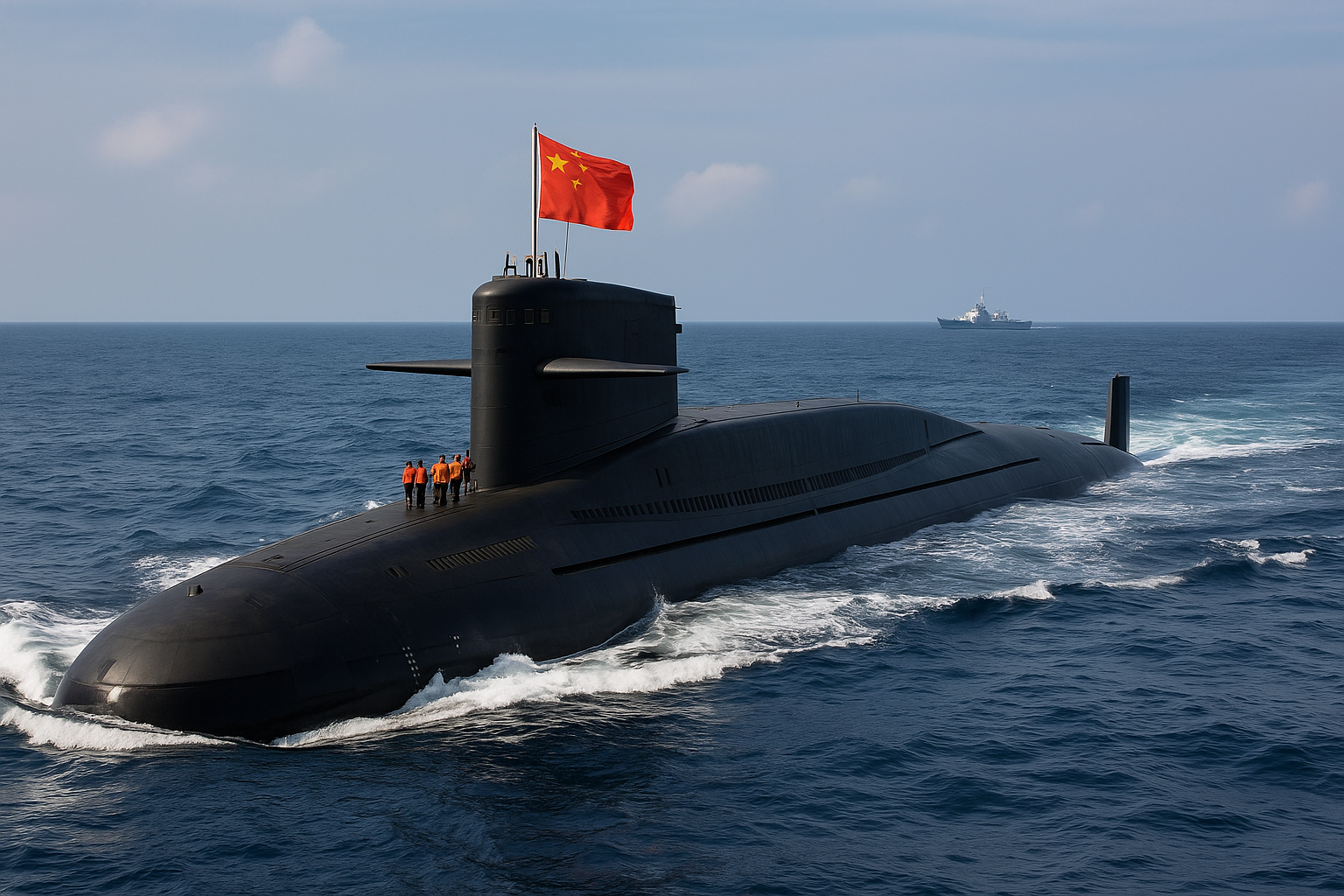
Introduction: Why Type 094 Submarine Operations in China Matter?
When we talk about nuclear deterrence and undersea power, most people think of missiles, bombs, and air bases. But one of the stealthiest and most strategic elements in China’s arsenal is the Type 094 — also known as the Jin-class SSBN. These submarines give China a sea-based nuclear option, meaning even if land-based missiles are detected or destroyed, China could still retaliate. That changes the whole game.
Because of that, understanding how China operates its Type 094 fleet is crucial — not just for defense analysts, but for anyone watching Indo-Pacific stability. In this article, we’ll walk you through how these subs work, what they’re capable of, where they patrol, and what strengths and limitations they bring to the table.
Type 094 Submarine Operations China Short Overview:
Type 094 submarine operations in China refer to how China deploys its nuclear ballistic missile submarines for strategic deterrence, using stealthy patrols, long-range missiles, and protected waters to maintain a survivable second-strike capability.
Type 094 Jin Class at a Glance
The Type 094 is a nuclear-powered ballistic missile submarine (SSBN) developed by the People’s Liberation Army Navy (PLAN). Each boat is about 135 meters long, and when submerged, displaces around 11,000 tons.
Powered by a pressurized-water nuclear reactor driving a single shaft, the Type 094 can stay underwater for extended periods — an essential trait for a credible sea-based deterrent. Its official military-disclosed max submerged speed recently was given as 30 knots, and test depth around 400 meters.
Each sub carries 12 vertical-launch missile tubes (SLBMs), plus several 533 mm torpedo tubes for self-defense and tactical flexibility.
All told, six Type 094 submarines are confirmed active in China’s fleet as of mid-2020s.
Where Type 094 Fits in China’s Submarine Fleet?
Type 094 isn’t the only submarine China operates — it’s part of a broader underwater force. The PLAN runs various classes: attack submarines, diesel-electric boats, older boats, and the newer strategic submarines.
This SSBN class was built to replace the older, less reliable Type 092 (Xia-class), which never offered a fully credible sea-based deterrent. At the same time, China is pushing ahead with newer submarine designs: for instance the Type 096 (next-generation SSBN) — meant to eventually supplement or supersede Type 094 — and attack submarines like Type 093 or planned Type 095, which provide escort and protection roles.
So Type 094 sits in the middle — not China’s largest or most advanced submarine ever, but currently its backbone for sea-based nuclear deterrence.
Primary Operation: Sea-Based Nuclear Deterrence & Second-Strike Capability
Here’s the core of why Type 094 matters. Its main mission is strategic deterrence. By lurking beneath the waves, hidden and mobile, these subs provide China with a credible second-strike capability — meaning even if land-based nukes are destroyed in a first strike, submarines can retaliate. That changes the balance: no first strike can guarantee total destruction of China’s nuclear forces.
Back in 2015, the U.S. Department of Defense called the Type 094 “China’s first credible sea-based nuclear deterrent.” Since then, the PLAN reportedly began regular deterrence patrols.
For China’s nuclear triad — land-based ICBMs, air-launched weapons (if any), and sea-based SLBMs — the submarine leg adds resilience. Even under heavy missile defense coverage or satellite surveillance, a submerged SSBN could remain hidden long enough to launch a retaliatory strike.
That’s why maritime strategists often say: the value of SSBNs isn’t just in war-fighting, but in maintaining strategic stability.
Missile Systems and Firepower on Patrol
At the heart of the Type 094’s deterrence is the JL-2 — a solid-fuel, three-stage submarine-launched ballistic missile (SLBM). Each Type 094 can carry 12 JL-2 missiles.
JL-2 has an estimated range of about 7,200–7,400 kilometers, enough to threaten regional adversaries and well beyond. With that range, a Type 094 stationed near Chinese waters could target strategic regional locations — a fact that fundamentally changes regional deterrence dynamics.
But guess what — China didn’t stop there. More recently, some Type 094 boats have reportedly been adapted to fire the newer JL-3 SLBM, which has considerably longer range. With JL-3, these submarines may pose a credible threat to long-distance targets — increasing China’s sea-based reach drastically compared with just a few years ago.
Besides missiles, the subs have 533 mm torpedo tubes (usually six) for close-range defense against ships or other submarines. That gives them some conventional warfare flexibility, though their primary role remains strategic deterrence.
How and Where Type 094 Submarines Actually Operate?
So where do these stealthy giants roam? China appears to rely heavily on a “bastion” strategy: keep the SSBNs near home waters, especially in areas shielded by air and naval defenses. The main base often flagged is on Hainan Island.
By patrolling closer to Chinese coastlines — and under the protective umbrella of nearby air and sea assets — the subs mitigate some of their weaknesses (like noise) and ensure survivability.
In 2023, a major milestone: a report highlighted that China appears to be maintaining at least one nuclear-armed ballistic missile submarine constantly at sea. That signals a shift: from occasional deterrence patrols toward near-continuous at-sea presence. Which means the second-strike force is no longer just theoretical — it’s being operationalized.
That shift matters strategically. A constant at-sea SSBN raises the uncertainty for any adversary considering a first strike. They simply cannot be sure all subs are destroyed.
Stealth, Noise, and Survivability: How Good Are Chinese Submarines?
Here’s the rub. For SSBNs, stealth is everything. If an enemy can detect and target you, the deterrent effect collapses. And by many accounts, Type 094 remains noisier than many equivalent Western or Russian subs.
Some open-source estimates claim the acoustic signature of Type 094 may be as loud as 120–140 decibels at low frequencies — louder than “quiet” submarines from U.S. or Russian fleets.
That means in open oceans — especially with modern anti-submarine warfare (ASW) tracking, sonar networks, and surveillance — Type 094 might be easier to detect and track, reducing its survivability.
On top of that, its compact size and older hull design limit space for advanced noise-dampening measures, and its missile load (12 SLBMs) is modest compared to larger SSBNs from other naval powers.
That said, China seems aware of these limitations. The newer variant, Type 094A, is believed to incorporate hull and sail modifications aimed at improving stealth and acoustic profile.
Chinese Submarines vs U.S. Submarines
If you put China’s SSBNs head-to-head with U.S. equivalents, several differences stand out. U.S. SSBNs (like the Ohio-class) are larger, quieter, and carry significantly more missiles and warheads. That gives them greater payload, flexibility, and survivability.
By contrast, Type 094 — while a serious step up from China’s earlier SSBN attempts — remains a more modest deterrent. Its missile count is lower, its stealth is weaker, and its global reach (at least with JL-2) is limited.
But here’s the nuance: deterrence isn’t just about matching power toe-to-toe. For China, having even a handful of SSBNs that can survive enough to retaliate provides a big strategic anchor. It doesn’t need to match U.S. numbers to change the risk calculus for any adversary.
Modernization, Type 094A, Type 096, and the Future of Chinese SSBN Operations
China isn’t standing still. The Type 094A — the improved version of the Jin-class — seems aimed at addressing key weaknesses: better stealth, possibly quieter engines or improved hydrodynamics, and updated missile systems.
Beyond that, China is developing the next-gen SSBN, the Type 096. Early reporting suggests it might carry more missiles, be quieter, and have longer-range SLBMs (likely JL-3).
In other words: Type 094 may be a transitional platform — vital now, but likely overtaken in future decades as China’s submarine force evolves. For now though, it’s the backbone of sea-based nuclear deterrence.
Type 094 vs Type 096 (Quick Guide)
| Feature | Type 094 | Type 096 (Future) |
| Role | Current nuclear SSBN | Next-gen nuclear SSBN |
| Missile System | JL-2 (range ~7,000 km) | JL-3 (potential 10,000+ km) |
| Missile Tubes | 12 | Estimated 16–24 |
| Stealth | Moderate (noisy) | Expected major improvement |
| Status | Active service | Under development |
| Strategic Impact | Regional deterrence | Expanded global reach |
Cost, Industrial Capacity, and Fleet Sustainability
Building and maintaining SSBNs isn’t cheap or easy. Estimated cost per unit of Type 094 has been put around US$750 million. Maintaining nuclear reactors, SLBMs, and submarine crews, plus regular patrols, requires steady industrial and logistical support.
Given China already fields six Type 094 boats, analysts expect the fleet could grow to 8–10 SSBNs over the coming decade — especially as Type 096 enters service.
That expansion would require upgraded shipyards, missile production, and robust maintenance infrastructure. As far as open-source reporting shows, China seems committed.
Risks, Limits, and Potential Conflict Scenarios Involving Type 094 Operations
Despite the promise, there are clear risks and limitations.
- First, the noise — a noisy submarine is vulnerable. In open oceans with sophisticated ASW (anti-submarine warfare) assets, Type 094 may struggle to remain hidden.
- Second, operational scope — historically, these boats have stayed nearer to coastal bastions rather than patrolling global oceans, limiting their deterrence to regional or near-sea threats.
- Third, command and control. Underwater communications, secure launch authorization, and coordination remain challenging, especially under crisis conditions.
In a hypothetical high-tension conflict — say an Indo-Pacific flashpoint — if adversaries focus on detecting and tracking these subs early, China’s second-strike guarantee could be weakened. That said, even limited survivability may be enough to deter escalation.
Expert Thoughts and Real-World Implications
From open-source intelligence and defence-analysis reports, several conclusions emerge:
- The Type 094 gives China its first dependable sea-based nuclear deterrent. That alone shifts regional strategic calculations.
- But it’s not flawless. Its acoustic signature and limited missile load place real constraints on its global reach and survivability.
- The emergence of Type 094A and upcoming Type 096 shows China’s strategy: build deterrence now, improve stealth and firepower over time.
- For neighbors and global powers watching the Indo-Pacific, the continued presence (and patrols) of these submarines will demand robust ASW surveillance, diplomatic caution, and updated strategic planning.
Conclusion: What Type 094 Submarine Operations in China Signal for the Future?
Here’s the bottom line: Type 094 submarine operations in China mark a major milestone. These Jin-class SSBNs transformed China from a mostly land-based nuclear force into a true triad power — with a sea-based leg that can survive a first strike and retaliate. That kind of deterrence changes the strategic calculus for everyone.
Yes, the subs have limitations. They’re louder, less well-armed than U.S. or Russian equivalents, and perhaps less stealthy. But in strategic deterrence, “good enough to survive” is often what matters more than “perfect stealth.”
On top of that, with modernizations (Type 094A) and future developments (Type 096, JL-3 missiles), China’s sea-based nuclear posture is likely only going to get stronger. For analysts, policymakers, or just anyone paying attention, these submarine operations are a clear signal: undersea deterrence is here to stay in China — and it matters.
FAQs
What is the main purpose of Type 094 submarine operations in China?
To provide China with a credible sea-based nuclear deterrent, ensuring it can retaliate even if its land-based forces are destroyed.
Where do Type 094 submarines usually operate?
Mostly in the South China Sea, near Hainan Island, using a “bastion strategy” that protects subs under strong naval and air cover.
How powerful are the missiles on Type 094 submarines?
They carry JL-2 missiles, capable of hitting targets up to ~7,200 km away. Some upgraded variants may use JL-3, with a longer range.
Is the Type 094 as advanced as U.S. submarines?
Not really. Type 094 is considered noisier and less stealthy than U.S. SSBNs, but still capable enough to provide credible deterrence.
How many Type 094 submarines does China have?
Open-source estimates suggest six active submarines, forming the backbone of China’s current nuclear-sub fleet.
Disclaimer:
This article is for informational and educational purposes only. All insights are derived from publicly available sources, reputable defense analyses, and open-source intelligence. We do not have access to classified information, and we do not promote, endorse, or support any military organization, government, or strategic agenda.

My name is Mustafa, and I have been blogging for over 5 years. I am passionate about sharing complete, accurate, and helpful information with my readers. Along with managing content on The Matcha Read, I also contribute blog posts to premium websites. My goal is to provide valuable insights in a clear and easy-to-understand way, so every reader walks away with useful knowledge.