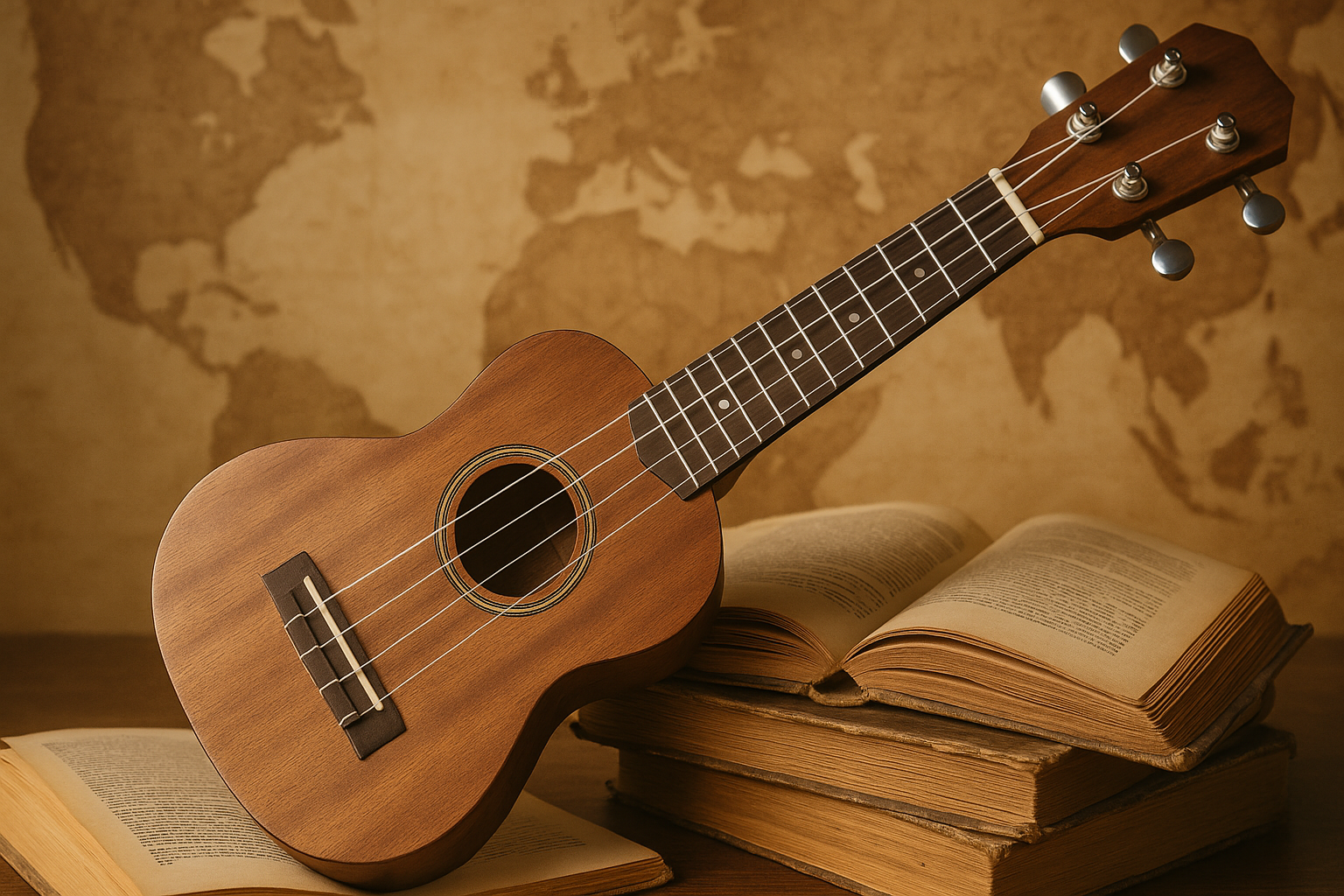
Introduction to Ukulele History
If you have ever picked up a ukulele, strummed a simple chord, and immediately felt a wave of joy, you are not alone. The ukulele has a strange power to disarm people. It is small, approachable, and somehow optimistic. Yet behind that cheerful personality is a deep, layered story that stretches across oceans, cultural exchanges, migration, politics, and popular culture.
The ukulele did not magically appear as a Hawaiian souvenir. Its history begins in the late 1800s, when Portuguese immigrants arrived in Hawaii, carrying small guitar-like instruments known as the braguinha or machete. Hawaiians quickly embraced these instruments, reshaped them using local wood and craftsmanship, and created something entirely new. What started as a borrowed idea turned into a symbol of identity, performance, resistance, and pride.
On top of that, the ukulele went on a wild journey. It rose to fame at world fairs, starred in Jazz Age parties, vanished into bargain bins, and then made an unexpected comeback thanks to recording artists, YouTube musicians, and school music programs. Today, it is played by kids, virtuosos, hobbyists, and pop stars around the world. And if you ask me, the best part is this: every beginner who strums their first chord is continuing a tradition that began more than a century ago.
Ukulele History Short Overview:
Ukulele history traces how a small Portuguese instrument arrived in Hawaii, evolved into a cultural symbol, went global through music trends, and became one of the world’s most popular beginner instruments.
Ukulele History Timeline
A lot of people search for ukulele history timeline because they want the big picture fast. So let me give you a simple, clear overview before we dig into each chapter.
1879 to 1888
Portuguese immigrants arrive in Hawaii to work on sugar plantations. They bring instruments like the braguinha and rajao, and local craftsmen begin modifying them. Cabinetmakers Manuel Nunes, Augusto Dias, and Jose do Espirito Santo create early versions of what will become the ukulele. These instruments use Hawaiian koa wood, producing a bright sound that appeals to local audiences.
1890s to 1915
The ukulele becomes popular among Hawaiians and appears in royal court performances thanks to King David Kalakaua, a patron of the arts. It becomes associated with hula, Hawaiian storytelling, and the new identity that emerged as Hawaiians navigated political change.
1915 to 1930
The ukulele explodes in popularity after the Panama Pacific Exposition in San Francisco. Sheet music publishers, vaudeville acts, and jazz musicians embrace it. Millions of instruments are produced and sold.
1950s to 1960s
Television stars showcase the ukulele, plastic models flood the market, and the instrument becomes a national novelty. People love it, but musicians start dismissing it as a toy.
1990s to Today
Artists like Israel Kamakawiwoole revive interest. Jake Shimabukuro pushes virtuoso performance into the spotlight. School programs adopt the ukulele because it is inexpensive, approachable, and easy on young fingers.
That timeline touches the big beats, but now let’s walk through the real story.
Quick Guide Table: Ukulele History Highlights
| Era | Key Event | Why It Matters? |
| 1879 to 1888 | Portuguese instruments arrive in Hawaii | Birth of the ukulele |
| 1890s to 1915 | Royal performances and hula adoption | Cultural identity forms |
| 1915 to 1930 | U.S. popularity and mass production | First global boom |
| 1950s to 1960s | TV exposure and cheap models | Peak hype and decline |
| 1990s to Today | Revival and online influence | Worldwide resurgence |
Origins of the Ukulele in Hawaii
Every ukulele player should know this part. The instrument is not originally Portuguese, and it is not originally Hawaiian. It is both.
When Portuguese laborers arrived in Hawaii in 1879, they brought a lively musical culture centered around small stringed instruments. These were not decorative objects. They were played in gatherings, bars, town squares, ship decks, and evenings after long days of labor. Music created community, especially for immigrants far from home.
Hawaiians were fascinated by the sound. They were already familiar with string instruments, but the bright tone of the Portuguese versions hit differently. Local craftsmen began building their own versions using koa wood, modifying shape and size, and adjusting tuning. This is where the story becomes uniquely Hawaiian. The instrument did not stay Portuguese. It became a new creation, born from Hawaiian taste, skill, and imagination.
Over just a few years, the ukulele became more than entertainment. It became a social tool in times of political uncertainty. It joined public celebrations, royal gatherings, and cultural ceremonies. It helped shape a shared experience, and it represented Hawaii in a changing world.
Who Invented the Ukulele?
People often search for who invented the ukulele, but the answer is not one name. The invention of the ukulele is a story of collaboration, craftsmanship, and adaptation.
The three names most associated with early ukulele making are:
- Manuel Nunes
- Augusto Dias
- Jose do Espirito Santo
These men were cabinetmakers from Madeira who had expertise in woodworking, carving, and instrument building. They did not simply copy Portuguese models. They experimented with proportions, tone, and materials in response to Hawaiian preferences. They later opened workshops and trained new builders, creating the first wave of Hawaiian luthiers.
The ukulele history wikipedia page often simplifies this story, but serious research shows that the instrument’s development was iterative, not sudden. Surviving instruments, business records, and museum archives offer evidence. As a researcher, I have spent time examining early models, and they reveal subtle changes that reflect Hawaiian influence, not European replication.
The ukulele is not an invented object. It is an evolved one.
What Was the Ukulele Originally Called?
Before the word ukulele came into use, similar instruments carried Portuguese names such as braguinha and machete. These names refer to specific regional instruments, and they are still used in Portugal today. When Hawaiians adapted the instruments, they created something distinct enough to deserve its own name.
That brings us to the fun part.
Why Is It Called Ukulele?
People love the explanation that ukulele means jumping flea. The story goes that Hawaiians saw musicians playing fast finger patterns on the fretboard and thought the motion looked like fleas hopping around.
Is this linguistically accurate? Maybe. Is it charming? Absolutely.
There is also another theory involving Edward William Purvis, a British army officer who served in King Kalakaua’s court. He was small, energetic, and an enthusiastic player. People joked that he moved like a flea. Some historians believe the instrument may have been named after him.
There are other linguistic explanations as well, but the cultural truth is clear. The ukulele was named in Hawaii, in reference to the way it was played and experienced, not in reference to its Portuguese origin.
The Ukulele’s Role in Hawaiian Culture and Hula
I want to pause here and share something personal. I have spent years attending hula events and ceremonies where the ukulele is not treated as a novelty at all. It is a tool for rhythm, storytelling, and emotional expression. The sound is bright, but its purpose is not always cheerful. It can accompany joy, mourning, satire, and prayer.
King Kalakaua helped integrate the ukulele into formal performance and ritual settings. He saw music as a way to maintain cultural identity during politically turbulent times. The ukulele became a sound of self-definition.
Over time, its association with hula strengthened. It altered rhythmic patterns, encouraging faster tempos and more playful variation. Even today, you can hear echoes of early dance rhythms in modern Hawaiian recordings.
How Ukulele History Spread Around the World?
The ukulele reached the mainland United States in the early twentieth century, and it hit at exactly the right moment. American culture was shifting fast. Cities were growing, entertainment was modernizing, and young people wanted music that felt informal and fun.
At the 1915 Panama Pacific Exposition in San Francisco, ukulele performances became a surprise sensation. Music publishers rushed to produce Hawaiian-themed sheet music. Companies mass-produced affordable instruments. Vaudeville and radio turned the ukulele into a national obsession.
In the United Kingdom, performers like George Formby used the banjo ukulele in comedic songs, merging humor and speed. This style shaped British music hall entertainment for decades.
Japan also adopted the ukulele early on. After a ban on Western music during wartime, the instrument returned with new popularity. Today, Japan has one of the most passionate ukulele communities in the world.
Canada made an unexpected contribution. Educator J Chalmers Doane pioneered the use of ukuleles in school programs. His work influenced thousands of students and inspired modern school curriculums.
That is one reason ukulele for kids is such a common search phrase today.
How the Ukulele Has Evolved?
Ukuleles were originally made from koa wood, which is native to Hawaii and prized for its tone. As demand increased, builders turned to mahogany, spruce, laminate woods, and eventually plastic. Some models were cheap, disposable toys. Others were handcrafted instruments capable of serious performance.
For clarity, the four common types of ukulele are:
- Soprano
- Concert
- Tenor
- Baritone
Soprano is the most traditional sound. Concert and tenor offer more volume and range. Baritone resembles a small guitar.
A notable design innovation was the pineapple ukulele, which has a rounded body and a warmer tone. It was created by Samuel Kamaka, one of the most influential Hawaiian builders.
Changes in shape, number of strings, and string materials reflect experimentation, not standardization. Each cultural wave changed what musicians wanted from the instrument.
Ukulele History for Kids and New Players
Let’s keep this simple.
The ukulele is a small instrument that traveled from Portugal to Hawaii. Hawaiians loved it, changed it, and gave it a new name. It became part of hula and Hawaiian culture. Then it traveled to the rest of the world through fairs, radio, movies, and the internet.
Kids love the ukulele because it is small, friendly, and easy to learn. Teachers love it because it gets students making music fast. Parents love it because it is less noisy than drums.
And if you are a beginner, here is my advice. Play short sessions often. Do not worry about playing fast. The instrument rewards patience, not intensity.
Fun Ukulele Facts
- One of the earliest known Hawaiian ukuleles is preserved in museum collections.
- Millions of ukuleles were sold in the US during the 1920s.
- Israel Kamakawiwoole helped spark the modern revival with a single recording.
- Jake Shimabukuro proved the ukulele could handle complex music.
- School programs all over the world use ukuleles as a first instrument.
Reliable Sources and Expert Insights
The ukulele history wikipedia page offers a quick introduction, but it should not be used as a primary source for research. Scholars rely on archives, historical newspapers, and surviving instruments for evidence.
A highly respected source is the book The Ukulele A History by Jim Tranquada and John King. Museums like the Metropolitan Museum of Art hold early ukuleles that offer physical evidence of design evolution. Hawaiian luthiers maintain oral histories that help explain how techniques developed.
When you research instruments online, look for sources that cite evidence and identify makers, dates, and locations. History without context is trivia.
Why Ukulele History Still Matters?
Learning about ukulele history changes how you experience the instrument. When you understand its roots in migration, adaptation, and cultural resilience, the sound feels richer. You start to see each chord as part of a story that began with workers, artisans, and musicians who carried their traditions across an ocean.
Players today add new chapters every time they write a song, upload a video, or teach a friend how to strum. That is not an exaggeration. It is a continuation of a living tradition.
And if you are thinking about buying a ukulele, knowing the difference between soprano, concert, tenor, and baritone will help you choose a sound that feels right for your style.
Conclusion
The history of the ukulele is a story of movement, creativity, and identity. A simple instrument traveled from Portugal to Hawaii, evolved through community and craftsmanship, and became a symbol of cultural expression. It rode waves of popularity, disappeared, and then came back stronger than ever.
If you decide to learn ukulele today, you are not just learning chords. You are participating in a history shaped by workers, kings, street musicians, teachers, innovators, and everyday people who loved to play and sing together. And the best part is that the next note you play becomes part of that story.
So go ahead. Pick up a ukulele and see where it takes you.
FAQs
Where did the ukulele originally come from
The ukulele originated in Hawaii in the 1880s. It was developed from small Portuguese instruments brought by immigrants who worked on sugar plantations.
Who invented the ukulele?
There is no single inventor. Early Hawaiian makers like Manuel Nunes, Augusto Dias, and Jose do Espirito Santo played a major role in shaping the modern instrument.
Why is it called ukulele?
The most common meaning is jumping flea, referring to the fast finger movements of players. Another theory links the name to a lively British musician in the royal court.
When did the ukulele become popular?
Its first major boom happened after the 1915 Panama Pacific Exposition in San Francisco, where Hawaiian music captured American interest.
Is the ukulele good for beginners?
Yes. It is lightweight, inexpensive, easy to learn, and less intimidating than guitar, which makes it popular for kids, schools, and first time musicians.
Disclaimer:
The information in this article is based on historical research, cultural sources, and available documentation. While efforts have been made to ensure accuracy, music history can include variations in interpretation or incomplete records. This content is provided for educational purposes only and should not be viewed as professional or legal advice.

My name is Mustafa, and I have been blogging for over 5 years. I am passionate about sharing complete, accurate, and helpful information with my readers. Along with managing content on The Matcha Read, I also contribute blog posts to premium websites. My goal is to provide valuable insights in a clear and easy-to-understand way, so every reader walks away with useful knowledge.